Unnamed repository; edit this file 'description' to name the repository.
1
2
3
4
5
6
7
8
9
10
11
12
13
14
15
16
17
18
19
20
21
22
23
24
25
26
27
28
29
30
31
32
33
34
35
36
37
38
39
40
41
42
43
44
45
46
47
48
49
50
51
52
53
54
55
56
57
58
59
60
61
62
63
64
65
66
67
68
69
70
71
72
73
74
75
76
77
78
79
80
81
82
83
84
85
86
87
88
89
90
91
92
93
94
95
96
97
# Usage

(Currently not fully documented, see the [keymappings](./keymap.md) list for more.)

See [tutor.txt](https://github.com/helix-editor/helix/blob/master/runtime/tutor.txt) (accessible via `hx --tutor` or `:tutor`) for a vimtutor-like introduction.

## Registers

Vim-like registers can be used to yank and store text to be pasted later. Usage is similar, with `"` being used to select a register:

- `"ay` - Yank the current selection to register `a`.
- `"op` - Paste the text in register `o` after the selection.

If there is a selected register before invoking a change or delete command, the selection will be stored in the register and the action will be carried out:

- `"hc` - Store the selection in register `h` and then change it (delete and enter insert mode).
- `"md` - Store the selection in register `m` and delete it.

### Special Registers

| Register character | Contains              |
| ---                | ---                   |
| `/`                | Last search           |
| `:`                | Last executed command |
| `"`                | Last yanked text      |
| `_`                | Black hole            |

> There is no special register for copying to system clipboard, instead special commands and keybindings are provided. See the [keymap](keymap.md#space-mode) for the specifics.
> The black hole register works as a no-op register, meaning no data will be written to / read from it.

## Surround

Functionality similar to [vim-surround](https://github.com/tpope/vim-surround) is built into
helix. The keymappings have been inspired from [vim-sandwich](https://github.com/machakann/vim-sandwich):
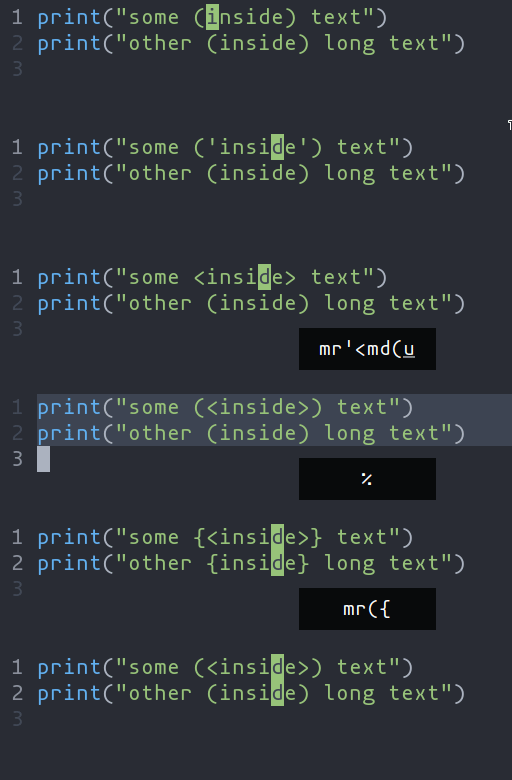
![surround demo](https://user-images.githubusercontent.com/23398472/122865801-97073180-d344-11eb-8142-8f43809982c6.gif)

- `ms` - Add surround characters
- `mr` - Replace surround characters
- `md` - Delete surround characters

`ms` acts on a selection, so select the text first and use `ms<char>`. `mr` and `md` work
on the closest pairs found and selections are not required; use counts to act in outer pairs.

It can also act on multiple selections (yay!). For example, to change every occurrence of `(use)` to `[use]`:

- `%` to select the whole file
- `s` to split the selections on a search term
- Input `use` and hit Enter
- `mr([` to replace the parens with square brackets

Multiple characters are currently not supported, but planned.

## Textobjects

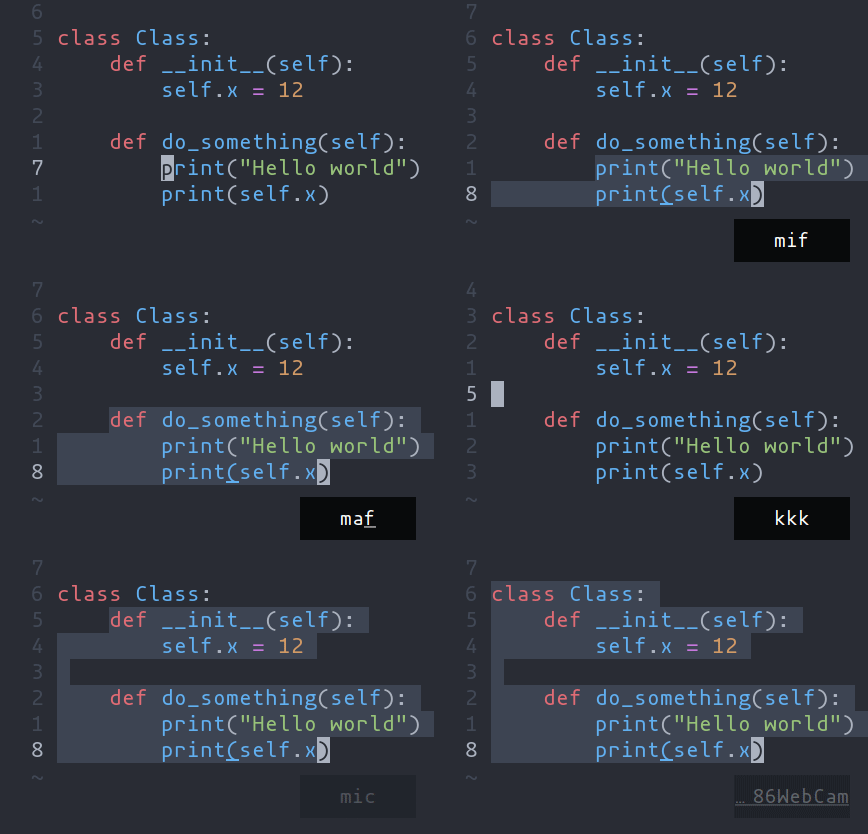
Currently supported: `word`, `surround`, `function`, `class`, `parameter`.

![textobject-demo](https://user-images.githubusercontent.com/23398472/124231131-81a4bb00-db2d-11eb-9d10-8e577ca7b177.gif)
![textobject-treesitter-demo](https://user-images.githubusercontent.com/23398472/132537398-2a2e0a54-582b-44ab-a77f-eb818942203d.gif)

- `ma` - Select around the object (`va` in vim, `<alt-a>` in kakoune)
- `mi` - Select inside the object (`vi` in vim, `<alt-i>` in kakoune)

| Key after `mi` or `ma` | Textobject selected      |
| ---                    | ---                      |
| `w`                    | Word                     |
| `W`                    | WORD                     |
| `(`, `[`, `'`, etc     | Specified surround pairs |
| `m`                    | Closest surround pair    |
| `f`                    | Function                 |
| `c`                    | Class                    |
| `a`                    | Argument/parameter       |
| `o`                    | Comment                  |

> NOTE: `f`, `c`, etc need a tree-sitter grammar active for the current
document and a special tree-sitter query file to work properly. [Only
some grammars][lang-support] currently have the query file implemented.
Contributions are welcome!

## Tree-sitter Textobject Based Navigation

Navigating between functions, classes, parameters, etc is made
possible by leveraging tree-sitter and textobjects queries. For
example to move to the next function use `]f`, to move to previous
class use `[c`, and so on.

![tree-sitter-nav-demo][tree-sitter-nav-demo]

See the [unimpaired][unimpaired-keybinds] section of the keybind
documentation for the full reference.

> NOTE: This feature is dependent on tree-sitter based textobjects
and therefore requires the corresponding query file to work properly.

[lang-support]: ./lang-support.md
[unimpaired-keybinds]: ./keymap.md#unimpaired
[tree-sitter-nav-demo]: https://user-images.githubusercontent.com/23398472/152332550-7dfff043-36a2-4aec-b8f2-77c13eb56d6f.gif
' href='#n268'>268 269 270 271 272 273 274 275 276 277 278 279 280 281 282 283 284 285 286 287 288 289 290 291 292 293 294 295 296 297 298 299 300 301 302 303 304 305 306 307 308 309 310 311 312 313 314 315 316 317 318 319 320 321 322 323 324 325 326 327 328 329 330 331 332 333 334 335 336 337 338 339 340 341 342 343 344 345 346 347 348
use std::iter::Peekable;
use std::ops::Range;
use std::sync::Arc;

use helix_core::Rope;
use helix_event::RenderLockGuard;
use imara_diff::Algorithm;
use parking_lot::{RwLock, RwLockReadGuard};
use tokio::sync::mpsc::{unbounded_channel, UnboundedSender};
use tokio::task::JoinHandle;
use tokio::time::Instant;

use crate::diff::worker::DiffWorker;

mod line_cache;
mod worker;

/// A rendering lock passed to the differ the prevents redraws from occurring
struct RenderLock {
    pub lock: RenderLockGuard,
    pub timeout: Option<Instant>,
}

struct Event {
    text: Rope,
    is_base: bool,
    render_lock: Option<RenderLock>,
}

#[derive(Clone, Debug, Default)]
struct DiffInner {
    diff_base: Rope,
    doc: Rope,
    hunks: Vec<Hunk>,
}

#[derive(Clone, Debug)]
pub struct DiffHandle {
    channel: UnboundedSender<Event>,
    diff: Arc<RwLock<DiffInner>>,
    inverted: bool,
}

impl DiffHandle {
    pub fn new(diff_base: Rope, doc: Rope) -> DiffHandle {
        DiffHandle::new_with_handle(diff_base, doc).0
    }

    fn new_with_handle(diff_base: Rope, doc: Rope) -> (DiffHandle, JoinHandle<()>) {
        let (sender, receiver) = unbounded_channel();
        let diff: Arc<RwLock<DiffInner>> = Arc::default();
        let worker = DiffWorker {
            channel: receiver,
            diff: diff.clone(),
            new_hunks: Vec::default(),
            diff_finished_notify: Arc::default(),
        };
        let handle = tokio::spawn(worker.run(diff_base, doc));
        let differ = DiffHandle {
            channel: sender,
            diff,
            inverted: false,
        };
        (differ, handle)
    }

    pub fn invert(&mut self) {
        self.inverted = !self.inverted;
    }

    pub fn load(&self) -> Diff {
        Diff {
            diff: self.diff.read(),
            inverted: self.inverted,
        }
    }

    /// Updates the document associated with this redraw handle
    /// This function is only intended to be called from within the rendering loop
    /// if called from elsewhere it may fail to acquire the render lock and panic
    pub fn update_document(&self, doc: Rope, block: bool) -> bool {
        let lock = helix_event::lock_frame();
        let timeout = if block {
            None
        } else {
            Some(Instant::now() + tokio::time::Duration::from_millis(SYNC_DIFF_TIMEOUT))
        };
        self.update_document_impl(doc, self.inverted, Some(RenderLock { lock, timeout }))
    }

    pub fn update_diff_base(&self, diff_base: Rope) -> bool {
        self.update_document_impl(diff_base, !self.inverted, None)
    }

    fn update_document_impl(
        &self,
        text: Rope,
        is_base: bool,
        render_lock: Option<RenderLock>,
    ) -> bool {
        let event = Event {
            text,
            is_base,
            render_lock,
        };
        self.channel.send(event).is_ok()
    }
}

/// synchronous debounce value should be low
/// so we can update synchronously most of the time
const DIFF_DEBOUNCE_TIME_SYNC: u64 = 1;
/// maximum time that rendering should be blocked until the diff finishes
const SYNC_DIFF_TIMEOUT: u64 = 12;
const DIFF_DEBOUNCE_TIME_ASYNC: u64 = 96;
const ALGORITHM: Algorithm = Algorithm::Histogram;
const MAX_DIFF_LINES: usize = 64 * u16::MAX as usize;
// cap average line length to 128 for files with MAX_DIFF_LINES
const MAX_DIFF_BYTES: usize = MAX_DIFF_LINES * 128;

/// A single change in a file potentially spanning multiple lines
/// Hunks produced by the differs are always ordered by their position
/// in the file and non-overlapping.
/// Specifically for any two hunks `x` and `y` the following properties hold:
///
/// ``` no_compile
/// assert!(x.before.end <= y.before.start);
/// assert!(x.after.end <= y.after.start);
/// ```
#[derive(PartialEq, Eq, Clone, Debug)]
pub struct Hunk {
    pub before: Range<u32>,
    pub after: Range<u32>,
}

impl Hunk {
    /// Can be used instead of `Option::None` for better performance
    /// because lines larger then `i32::MAX` are not supported by `imara-diff` anyways.
    /// Has some nice properties where it usually is not necessary to check for `None` separately:
    /// Empty ranges fail contains checks and also fails smaller then checks.
    pub const NONE: Hunk = Hunk {
        before: u32::MAX..u32::MAX,
        after: u32::MAX..u32::MAX,
    };

    /// Inverts a change so that `before`
    pub fn invert(&self) -> Hunk {
        Hunk {
            before: self.after.clone(),
            after: self.before.clone(),
        }
    }

    pub fn is_pure_insertion(&self) -> bool {
        self.before.is_empty()
    }

    pub fn is_pure_removal(&self) -> bool {
        self.after.is_empty()
    }
}

/// A list of changes in a file sorted in ascending
/// non-overlapping order
#[derive(Debug)]
pub struct Diff<'a> {
    diff: RwLockReadGuard<'a, DiffInner>,
    inverted: bool,
}

impl Diff<'_> {
    pub fn diff_base(&self) -> &Rope {
        if self.inverted {
            &self.diff.doc
        } else {
            &self.diff.diff_base
        }
    }

    pub fn doc(&self) -> &Rope {
        if self.inverted {
            &self.diff.diff_base
        } else {
            &self.diff.doc
        }
    }

    pub fn is_inverted(&self) -> bool {
        self.inverted
    }

    /// Returns the `Hunk` for the `n`th change in this file.
    /// if there is no `n`th change  `Hunk::NONE` is returned instead.
    pub fn nth_hunk(&self, n: u32) -> Hunk {
        match self.diff.hunks.get(n as usize) {
            Some(hunk) if self.inverted => hunk.invert(),
            Some(hunk) => hunk.clone(),
            None => Hunk::NONE,
        }
    }

    pub fn len(&self) -> u32 {
        self.diff.hunks.len() as u32
    }

    pub fn is_empty(&self) -> bool {
        self.len() == 0
    }

    pub fn next_hunk(&self, line: u32) -> Option<u32> {
        let hunk_range = if self.inverted {
            |hunk: &Hunk| hunk.before.clone()
        } else {
            |hunk: &Hunk| hunk.after.clone()
        };

        let res = self
            .diff
            .hunks
            .binary_search_by_key(&line, |hunk| hunk_range(hunk).start);

        match res {
            // Search found a hunk that starts exactly at this line, return the next hunk if it exists.
            Ok(pos) if pos + 1 == self.diff.hunks.len() => None,
            Ok(pos) => Some(pos as u32 + 1),

            // No hunk starts exactly at this line, so the search returns
            // the position where a hunk starting at this line should be inserted.
            // That position is exactly the position of the next hunk or the end
            // of the list if no such hunk exists
            Err(pos) if pos == self.diff.hunks.len() => None,
            Err(pos) => Some(pos as u32),
        }
    }

    pub fn prev_hunk(&self, line: u32) -> Option<u32> {
        let hunk_range = if self.inverted {
            |hunk: &Hunk| hunk.before.clone()
        } else {
            |hunk: &Hunk| hunk.after.clone()
        };
        let res = self
            .diff
            .hunks
            .binary_search_by_key(&line, |hunk| hunk_range(hunk).end);

        match res {
            // Search found a hunk that ends exactly at this line (so it does not include the current line).
            // We can usually just return that hunk, however a special case for empty hunk is necessary
            // which represents a pure removal.
            // Removals are technically empty but are still shown as single line hunks
            // and as such we must jump to the previous hunk (if it exists) if we are already inside the removal
            Ok(pos) if !hunk_range(&self.diff.hunks[pos]).is_empty() => Some(pos as u32),

            // No hunk ends exactly at this line, so the search returns
            // the position where a hunk ending at this line should be inserted.
            // That position before this one is exactly the position of the previous hunk
            Err(0) | Ok(0) => None,
            Err(pos) | Ok(pos) => Some(pos as u32 - 1),
        }
    }

    /// Iterates over all hunks that intersect with the given line ranges.
    ///
    /// Hunks are returned at most once even when intersecting with multiple of the line
    /// ranges.
    pub fn hunks_intersecting_line_ranges<I>(&self, line_ranges: I) -> impl Iterator<Item = &Hunk>
    where
        I: Iterator<Item = (usize, usize)>,
    {
        HunksInLineRangesIter {
            hunks: &self.diff.hunks,
            line_ranges: line_ranges.peekable(),
            inverted: self.inverted,
            cursor: 0,
        }
    }

    pub fn hunk_at(&self, line: u32, include_removal: bool) -> Option<u32> {
        let hunk_range = if self.inverted {
            |hunk: &Hunk| hunk.before.clone()
        } else {
            |hunk: &Hunk| hunk.after.clone()
        };

        let res = self
            .diff
            .hunks
            .binary_search_by_key(&line, |hunk| hunk_range(hunk).start);

        match res {
            // Search found a hunk that starts exactly at this line, return it
            Ok(pos) => Some(pos as u32),

            // No hunk starts exactly at this line, so the search returns
            // the position where a hunk starting at this line should be inserted.
            // The previous hunk contains this hunk if it exists and doesn't end before this line
            Err(0) => None,
            Err(pos) => {
                let hunk = hunk_range(&self.diff.hunks[pos - 1]);
                if hunk.end > line || include_removal && hunk.start == line && hunk.is_empty() {
                    Some(pos as u32 - 1)
                } else {
                    None
                }
            }
        }
    }
}

pub struct HunksInLineRangesIter<'a, I: Iterator<Item = (usize, usize)>> {
    hunks: &'a [Hunk],
    line_ranges: Peekable<I>,
    inverted: bool,
    cursor: usize,
}

impl<'a, I: Iterator<Item = (usize, usize)>> Iterator for HunksInLineRangesIter<'a, I> {
    type Item = &'a Hunk;

    fn next(&mut self) -> Option<Self::Item> {
        let hunk_range = if self.inverted {
            |hunk: &Hunk| hunk.before.clone()
        } else {
            |hunk: &Hunk| hunk.after.clone()
        };

        loop {
            let (start_line, end_line) = self.line_ranges.peek()?;
            let hunk = self.hunks.get(self.cursor)?;

            if (hunk_range(hunk).end as usize) < *start_line {
                // If the hunk under the cursor comes before this range, jump the cursor
                // ahead to the next hunk that overlaps with the line range.
                self.cursor += self.hunks[self.cursor..]
                    .partition_point(|hunk| (hunk_range(hunk).end as usize) < *start_line);
            } else if (hunk_range(hunk).start as usize) <= *end_line {
                // If the hunk under the cursor overlaps with this line range, emit it
                // and move the cursor up so that the hunk cannot be emitted twice.
                self.cursor += 1;
                return Some(hunk);
            } else {
                // Otherwise, go to the next line range.
                self.line_ranges.next();
            }
        }
    }
}